

_Municipal_Seal.png&w=64&q=75 "Municipality of New Lucena, Iloilo")
What Makes a Sound High or Low?
In the Cry of Jelicuon, the live musical ensemble does far more than provide background sound — it controls the entire emotional arc of the performance. The low rumble of the bass drum signals tension; the bright burst of the trumpet signals triumph. Not every team relies on live instruments, though: some perform to recorded music played through a sound system, where amplifiers and loudspeakers reproduce the same frequencies at a much larger amplitude so the whole plaza can hear them. Whether the source is a live drum skin or a loudspeaker cone, both work by vibrating air. This emotional language is written in frequency. Frequency is the number of complete vibration cycles per second, measured in Hertz (Hz). The higher the frequency, the higher the perceived pitch.
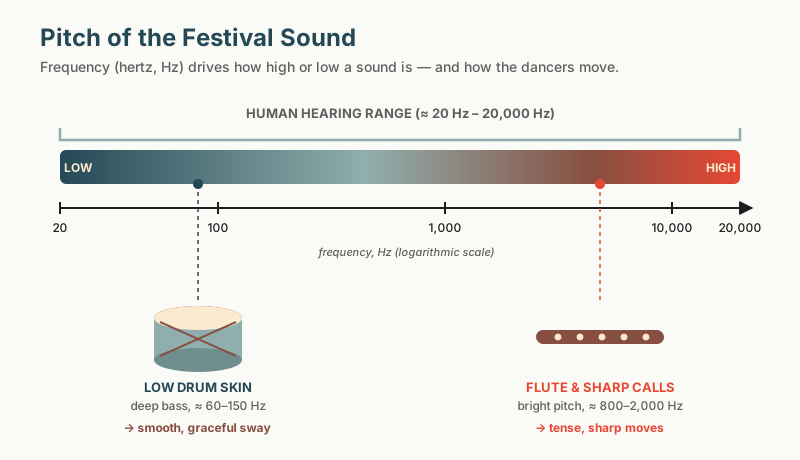
Human hearing detects frequencies from about 20 Hz (very deep bass, felt more than heard) to 20,000 Hz (extremely high, like a dog whistle). Festival instruments occupy a wide range: bass drums sit at 60–100 Hz, snare drums at 150–300 Hz, trumpets around 300–1000 Hz, and flutes at 800–2000 Hz. A performer listening to the ensemble can instinctively tell which instrument is leading — because pitch directly encodes frequency.
The wave equation v = fλ connects frequency (f) and wavelength (λ). In air at room temperature, sound travels at approximately 343 m/s regardless of pitch. This means frequency and wavelength are inversely proportional: if the festival trumpet plays at 440 Hz, its wavelength is λ = 343 / 440 ≈ 0.78 m. The bass drum at 80 Hz has λ = 343 / 80 ≈ 4.3 m — more than five times longer.
Frequency as a Choreographic Code in the Cry of Jelicuon
In the Cry of Jelicuon reenactment, the varying frequency of the live ensemble directly shapes how performers move. High-frequency sounds — sharp, high-pitched instrumental calls — signal moments of high tension, prompting performers to execute sharp, intense movements that mirror the urgency of the 1898 revolt. Low-frequency patterns, by contrast, cue female dancers to perform smoother, more graceful movements such as swaying and waving handheld lamps — portraying the peaceful daily life of New Lucenanhons before the uprising. Frequency, in this context, is not just a physical property of sound but the choreographer's primary language for directing emotional intensity across the entire ensemble.