

_Municipal_Seal.png&w=64&q=75 "Municipality of New Lucena, Iloilo")
Power: Work Done Fast
P = W / t. Power is not how much effort, but how fast that effort is spent.Work and energy tell us how much effort goes into a task. Power tells us how fast that effort is applied. In physics, power is the rate at which work is done: P = W / t. The unit of power is the Watt (W), where 1 W = 1 Joule per second. The same task done in half the time requires double the power.
P = W / tP = 600 / 3P = 200 WA crew member moves a prop doing 600 J of work in 3 seconds — a power output of 200 W. The same task in 6 seconds requires only 100 W. Doing work faster always demands more power.
Before the Cry of Jelicuon: Rehearsal Power
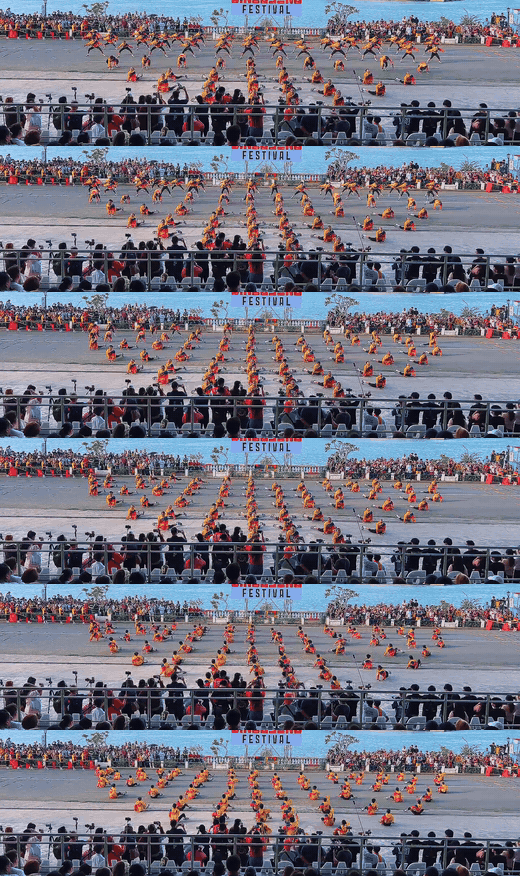
Student performers complete warm-up drills — push-ups, planks, and running intervals — within timed windows set by the choreographer. When performers finish 20 push-ups in 30 seconds versus 60 seconds, the faster set demonstrates higher muscular power output. The total work done (force × displacement of the body's center of mass) is the same, but the shorter time interval means the muscles are working at a higher rate. Teachers assembling props on a deadline face the same physics: completing heavy carpentry in two hours instead of four requires double the power from the same workers.
During the Performance: Snap and Burst
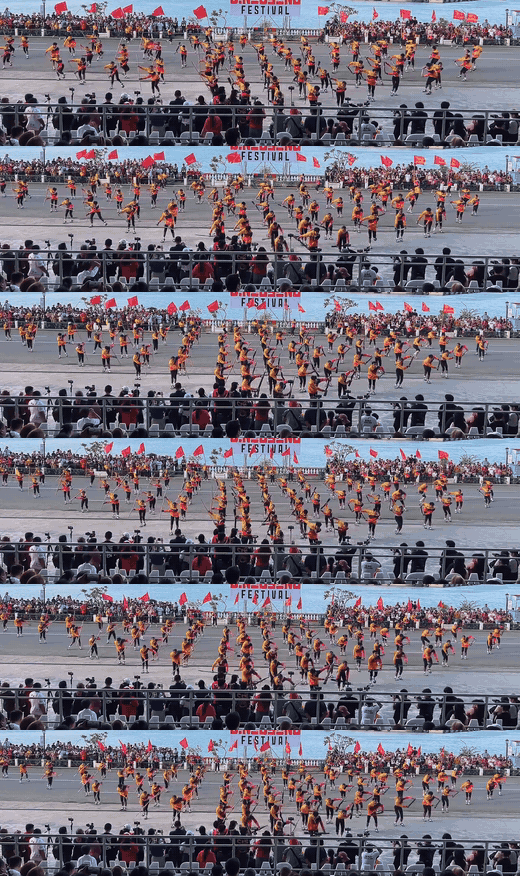
The war scene demands explosive movements — a kick, a jump, or a dramatic direction change — executed within a single beat count. A beat at 120 BPM lasts only 0.5 seconds. To deliver a high-impact kick that requires 100 J of work within that window: P = 100 J / 0.5 s = 200 W. If the choreographer speeds up the tempo, the same kick now happens in 0.25 seconds — requiring 400 W. This is why physically fit performers with high muscular power can execute crisper, more synchronized movements. Propsmen face the same physics: accelerating a riser from rest to its target position before the music cue requires a high initial power burst to build momentum quickly.
After the Cry of Jelicuon: Racing the Clock
Once the cultural presentation ends, all props, chairs, tables, and stage structures must be cleared before the next school performs. The LGU crew has a fixed window — typically 15 minutes — to move enormous loads out of the venue. The total work done (lifting, pushing, pulling hundreds of kilograms over dozens of meters) is the same regardless of schedule. But finishing in 10 minutes instead of 20 means the crew operates at twice the power output. This is why larger crews are assigned to the post-performance cleanup: more people doing work simultaneously increases the total power available to the team.